Country-by-country US time-zone overlap, which meetings need live hours, and a practical embedded-engineer schedule.
ops · By Alvaro Aquije · · 7 min read
Loading document…
Twenty minutes. You leave knowing whether we can fill the role.
Tell us the stack, the scope and the seniority. On the call you get a straight answer on whether we can fill it and what it would cost. If we take it on, a founder pairs with each candidate and you get one to three names with the write-ups attached. If nobody clears the bar, we say so instead of padding the list.
Rates and time-zone practices reviewed September 2026. An embedded engineer is an engineer who works inside the client's own repo, board and standup rather than through an agency delivery process. For US teams, location matters less than whether both sides protect enough live time to review work, resolve ambiguity and handle incidents without waiting overnight.
Latin American engineers normally share four to six working hours with US teams; exact hours depend on country, season and chosen schedule.
Overlap by country
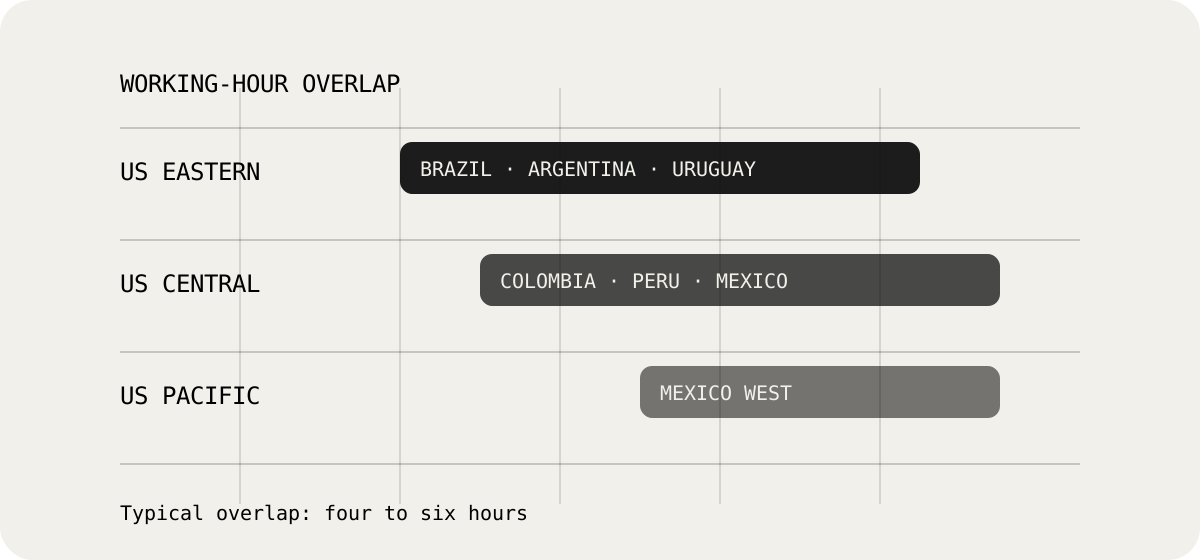
Latin American engineers through wepair.works work four to six hours of overlap with US working hours, with exact clock times agreed in the statement of work. That range is wide enough for standup, review, pairing and incident handoff while leaving uninterrupted blocks on both calendars. It is not a promise that every country shares the same clock or that daylight-saving changes never matter.
Brazil, Argentina and Uruguay align most naturally with US Eastern time. A conventional 9:00 to 18:00 local day in São Paulo, Buenos Aires or Montevideo covers most of an Eastern team's morning and afternoon. During parts of the year, local clocks differ by one or two hours because the United States changes for daylight saving while many Latin American countries do not. The practical fix is to agree a stable overlap window in the client's time zone, not to memorize an offset that changes twice a year.
Colombia, Peru, Ecuador and parts of Mexico align closely with US Central or Eastern time. Bogotá and Lima do not make seasonal clock changes, so the US relationship shifts when American clocks move. An engineer can still keep a stable four-to-six-hour client window by moving local start and end times by one hour at the seasonal boundary. That change belongs in a calendar note and a team reminder, not in an emergency message after someone misses standup.
Mexico needs city-level treatment because one country contains several time zones and daylight-saving rules differ near the US border. A candidate in Mexico City, Guadalajara or Monterrey may have a different overlap with a Pacific team than a candidate in Tijuana. Hiring pages that say “Mexico is in Central time” erase a detail that changes meeting attendance. wepair.works records city, IANA zone and client overlap in each role brief.
Chile also needs seasonal attention. Its clock changes do not always happen on the same date as changes in the United States. A recurring meeting created with named zones usually survives correctly; a meeting created as “UTC minus four” often does not. Use location-based zones in calendars and production schedules.
Four shared hours buy a US and Latin American engineering team one complete decision cycle on the same working day. A developer can raise a blocked requirement, get product context, change the implementation, request review and answer review feedback before either side signs off. With no shared hours, each question becomes a full-day round trip even when each person responds quickly.
Overlap should be treated as decision bandwidth, not presence tracking. Requiring someone to display a green status for eight US hours narrows the candidate pool without proving useful work happened. A better contract names the recurring events the engineer must attend, the hours in which urgent questions receive a live response and the handoff expected before either side leaves.
Four hours are enough when work is prepared. Standup starts with tickets already updated. Design review has a short written proposal before the call. Pull requests state the problem and tradeoffs rather than forcing reviewers to reconstruct them. Product decisions are recorded after the meeting. Shared time then handles disagreement and ambiguity, while private time handles implementation.
Six shared hours help teams with heavy pairing, frequent customer escalation or an active migration. Extra overlap also matters during the first two weeks, when a new engineer needs rapid answers about naming rules, access, deployment and ownership. It should not become a permanent substitute for documentation. If the sixth hour is spent asking the same unwritten question every day, the problem is not geography.
The cost of missing overlap appears in queue time. A ten-minute clarification sent after one side finishes becomes a blocked ticket until tomorrow. Five such clarifications across a sprint can consume more elapsed time than a larger implementation task. Nearshore work does not remove communication cost; it compresses the feedback loop enough that teams can see and fix it.
Rituals that need live time
Live time should be reserved for work where another person's immediate response changes the next action. Technical pairing, architecture tradeoffs, incident response, product ambiguity and difficult review comments fit that rule. Status reading, routine updates and information broadcast do not.
A daily standup can be live, but it earns its slot only if blockers are resolved there. Reading three ticket summaries aloud uses overlap without creating decisions. Many teams keep a short live standup three days a week, use written updates on the other days and pull the right people into a call when a blocker needs them.
Pairing sessions need protected overlap because control moves between people quickly. A senior engineer can expose assumptions by asking why a transaction boundary exists, why a component owns state or what should happen after a partial deploy. Recording a session helps absent teammates, but it does not replace being able to challenge the decision while code is changing.
Design and architecture reviews need live time after a proposal exists. A blank-call brainstorm rewards whoever speaks fastest. A one-page proposal lets everyone arrive with questions, then shared hours are spent on constraints and consequences. The engineer in Latin America should author proposals, not only attend reviews written by US colleagues; ownership requires shaping decisions before implementation.
Incidents need an explicit response window. If an engineer joins on-call, the team must define which hours are covered, who receives a page outside those hours and how ownership transfers. “Good overlap” is not an on-call policy. A handoff should name current impact, actions already taken, unsafe actions, next check and person responsible.
One-to-ones and early onboarding conversations also deserve live time. Remote engineers lose context when every conversation is transactional. A recurring conversation with their technical lead surfaces missing access, unclear authority and feedback before those issues become delivery problems.
Rituals that must be async
Async work should carry facts that remain useful after a meeting ends. Decisions, ticket state, deployment instructions, incident timelines and review reasoning belong in durable text. If a new engineer must ask who approved a change, the meeting produced conversation but not organizational memory.
Ticket updates should say what changed, what remains and what decision is blocked. “Still working” cannot be acted on across any time zone. A useful update might say the schema migration is ready, production volume is still unknown and rollout cannot proceed until an owner confirms the lock budget. That sentence lets someone answer without scheduling a meeting.
Pull requests should lead with problem, approach, risk and verification. Remote review gets slow when a reviewer must infer why files changed. Screenshots and short recordings help visual changes, but they supplement the written contract; searchable text remains easier to quote, revisit and challenge.
Architecture decisions need an owner and date. A short decision record should include considered alternatives and the condition that would cause the team to revisit the choice. That practice helps every distributed team, not only a US–Latin America team. Time-zone distance makes the cost of skipping it visible sooner.
End-of-day handoffs matter when work continues after some teammates leave. A good handoff says whether the branch is safe to use, whether a deploy is running, which alert would change the plan and when the author returns. It should never invite a teammate to continue dangerous work without enough context merely to create the appearance of round-the-clock delivery.
The founder digest wepair.works sends weekly or every two weeks is async by design. It records what shipped, what stalled, where the engineer pushed back and what the client should fix. Written delivery means the CTO can inspect the reasoning without attending another status call, then use overlap for any disagreement the digest surfaces.
A sample working day
A sample Bogotá-to-New-York schedule gives the engineer a long build block plus five shared hours. At 08:00 local, the engineer reads overnight review, updates the board and works on the hardest implementation task before messages accelerate. At 10:00, live overlap begins with a short standup or blocker review. Product and design conversations sit between 11:00 and 13:00. Pull-request review and pairing happen from 13:00 to 15:00. The engineer posts a handoff before ending at 17:00 local.
A Pacific team can shift that schedule later, but it should ask whether late local hours are sustainable. An engineer who works until 20:00 every day may accept the role and leave when a better schedule appears. Stable overlap is part of retention. wepair.works records the candidate's real schedule before introduction rather than assuming anyone in Latin America will mirror a US coast indefinitely.
Week one carries more live time than week ten. New engineers need access walkthroughs, domain vocabulary, deployment context and fast correction. After that, recurring calls should shrink as written context improves. If meetings grow every month, the operating model is accumulating confusion.
Teams hiring through wepair.works' Latin American developer process agree overlap during the role brief, see the candidate's city and schedule before interview, then test collaboration in a live pairing session. The goal is not geographic proximity by itself. The goal is a working day where questions become decisions before tomorrow.